
Ask any controller what worries them about letting AI touch a forecast, and you will not hear "it might be slow." You will hear: "How would I know what it changed?"
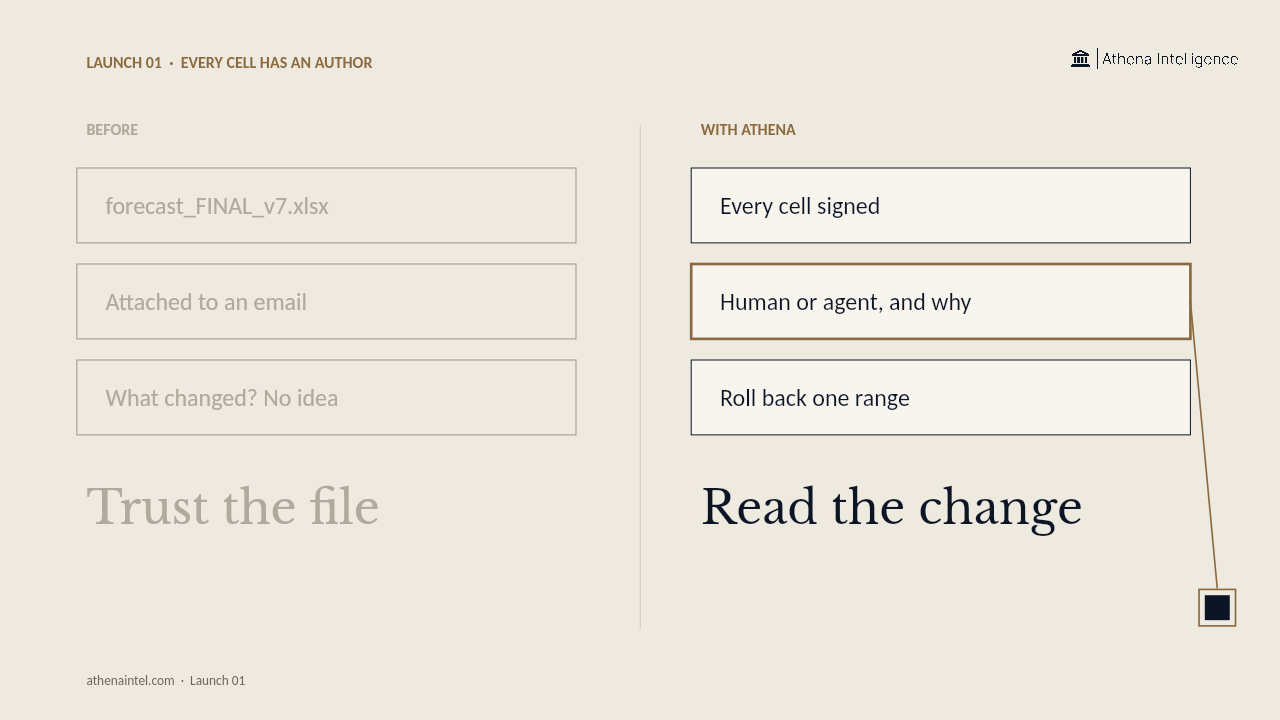
It is the right question. A common pattern is to get back a new file and a summary. Now you have two versions of the model and a paragraph of reassurance. Checking it means reading every tab again. So people either trust it blindly or redo the work, and neither is what anyone wanted.
We built Athena Sheets around the answer.
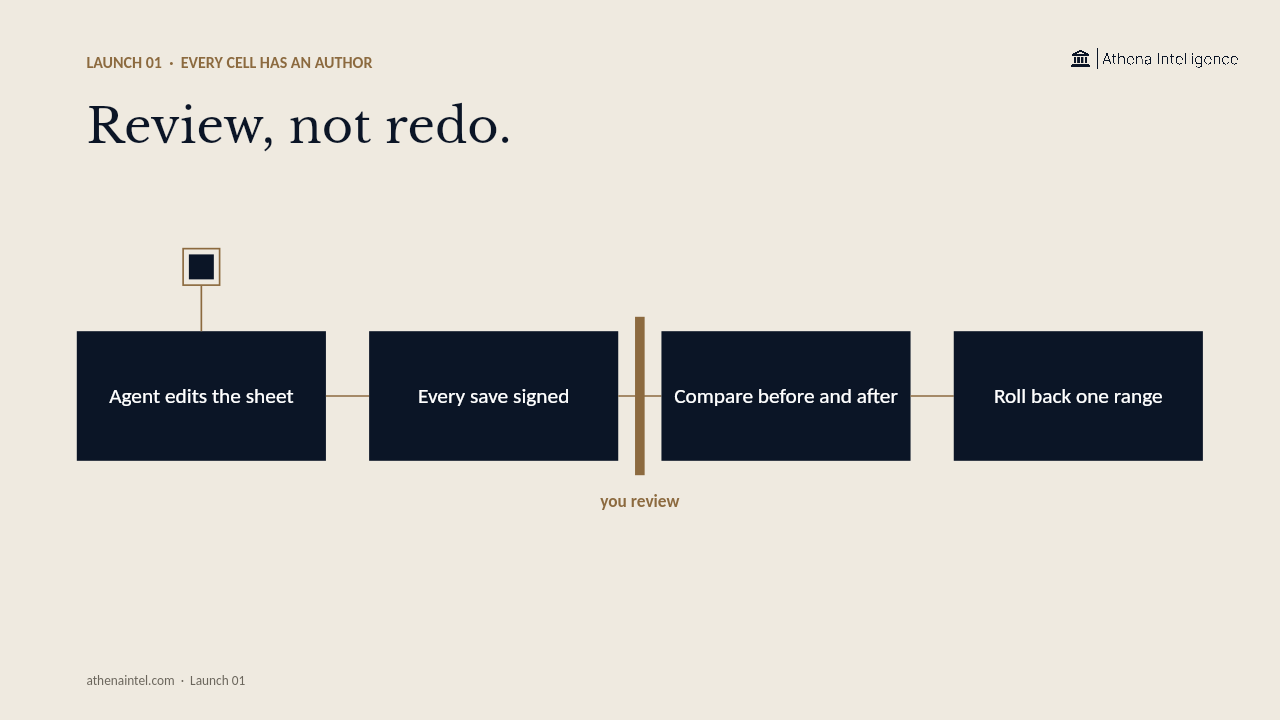
Every change is signed. Each time a person or an agent saves, Athena records who it was, the conversation that led to it, and what the cell said before and after. Click any cell, column, or range and the history is right there. If an agent made the change, you can open the conversation and read its reasoning in plain English.
You undo only what you disagree with. Roll back one range and keep everything else. Or open Compare and look at before and after side by side before anyone presents.
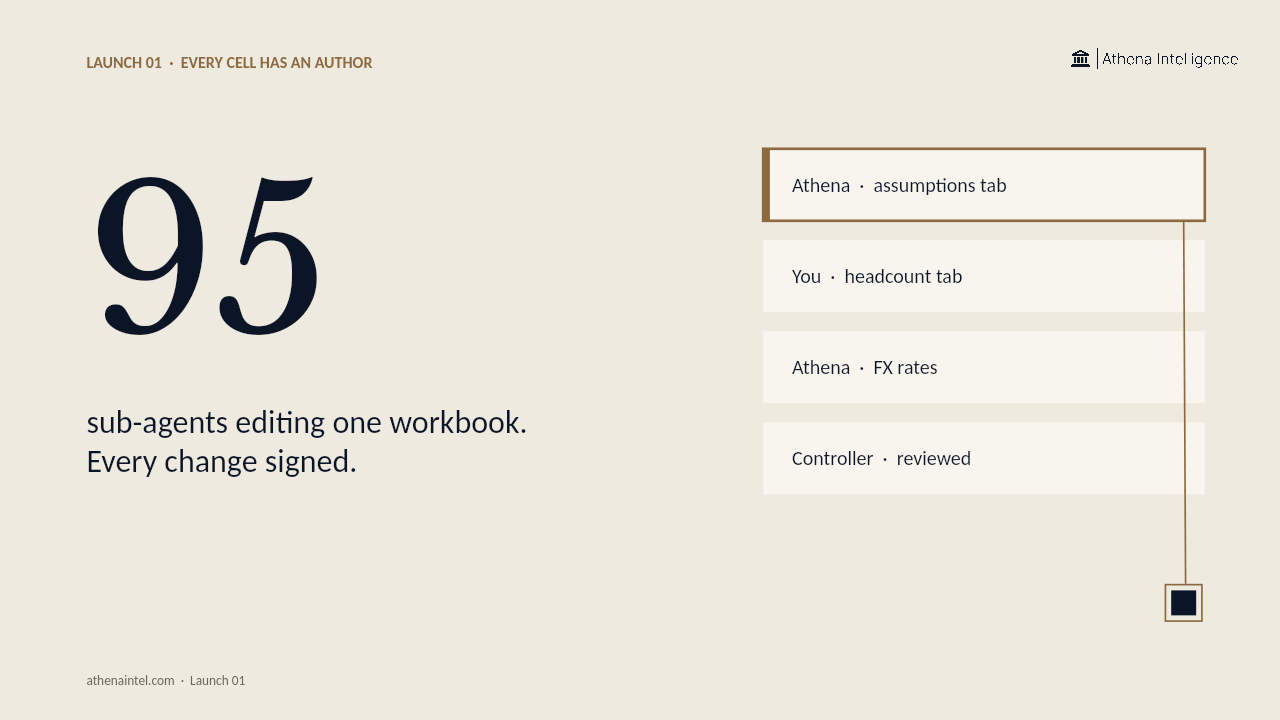
It holds up at real scale. Athena Sheets handle files over a million rows. In testing, 95 sub-agents edited the same workbook at once, and every one of their changes was signed. If you work in desktop Excel, the Office add-in syncs with Athena Sheets with the history intact. Word and PowerPoint documents in Athena work the same way.
History is kept per save, not per keystroke. If you and an agent change the same cell inside a single save, the last one wins. You still see the before and after.
This is what makes it reasonable to let an agent into the numbers at all. Not blind trust. Being able to check.
Review, not redo.
Every save records who and why
Each time a person or an agent saves in Athena Sheets, the system records who it was, the conversation that led to it, and what the cell said before and after. Click any cell, column, or range and the history is right there. If an agent made the change, you can open the conversation and read its reasoning in plain English.
This is not a summary or a log you export later. The attribution lives with the cell. A controller opens the change history over coffee, sees 4,000 cells updated the night before the board meeting, reads the reason, finds one wrong assumption on row 212, rolls back that range, and keeps the rest. Four minutes.
Roll back one range and keep the rest
You undo only what you disagree with. Roll back one range and keep everything else. Or open Compare and look at before and after side by side before anyone presents. Attribution is by cell, row, column, or range: author, time, before, after. The same model covers Word and PowerPoint documents in Athena.
Sheets handle files over a million rows. In testing, 95 sub-agents edited the same workbook at once, and every one of their changes was signed. If you work in desktop Excel, the Office add-in syncs back with the history intact.
Built with a global professional services firm
Athena was built with a global professional services firm. The attribution model is why regulated buyers can let an agent touch the numbers at all. In production for over a year, the system tracks work-product lineage: which agent, which sources, which human approved, which version the reviewer saw.
Every claim the agent makes carries a deep link to the page, cell, slide, shape, timestamp, or line. Citations are version-aware: if the source changed after the agent read it, the citation shows a flag and opens the version the agent saw. Approved states of an Agent Operating Procedure become restorable versions. Change the AOP, break it, restore Tuesday's. Athena takes a snapshot after every message in a Session; roll back, or restore as a new Session and keep both.
Where it fits with tools you use
If you work in desktop Excel, the Office add-in syncs back with the history intact. Word and PowerPoint documents in Athena work the same way. Files kept in SharePoint open in a Studio for editing; the trail lives with the asset and exports with it. Export the audit log per asset or per workspace. Whoever has edit rights on the asset can roll back, subject to your policy. Rollbacks are themselves attributed.
This is what makes it reasonable to let an agent into the numbers at all. Not blind trust. Being able to check.